A hearty congratulations to the volcanic volk on the isle of Iceland who recently rejected talks on joining the EU. After careful consideration and deliberation, voters decided that they didn’t want what Ceuta and Lampedusa were having. Or Stockholm, Berlin and Brussels, it might be better to say, since mass migration isn’t likely to come to Iceland on rickety boats but on budget airlines. 52.8% of voters managed to figure this equation out, while 47.2% apparently could do with more gang crime, welfare abuse, overrun schools, pickpockets, sharia law, “barber shops,” acid attacks, groomed children, FGM and more.
A quick look at polling data shows groups generally voted as expected. City-dwellers, left-wingers, women and university-educated (indoctrinated) all supported opening talks with the EU, according to local polling. Luckily Iceland has 10,000 more men than women, which is a lot in a country of 396,000. The big surprise was that the 70+ age bracket heavily supported the EU (58%), which seems to be indicative of some kind of older boomer / legacy media effect. The youth vote also apparently swung from 63% pro-EU in June to just 40% by election day, so survey reliability is questionable.
Nevertheless, it is by a whisker or two that this cosey and quaint Arctic island avoids the disaster that the EU is (for the rest of Europe). The scary thing? It was just one policy issue that made the difference… no, not migration but FISHERIES. This industry represents close to 40% of exports, so joining the EU would enforce catch quotas unfavorable to Iceland and open up the sector to foreign ownership.
Iceland is still a peaceful, high-trust society with enviable living standards and democratic values. They famously jailed some of their bankers. The country has plenty of firearms but usually experiences only 2 homicides per year. In 2013, the BBC ran an article attempting to answer this great paradox—arriving at the conclusion that it was because of the “education system, social welfare, egalitarian culture and the fact that 97% of inhabitants identify with the middle or working class.” All correlations, of course, not causation.
Iceland rightfully has one of strongest country brands in Europe (along with Switzerland and Norway—all non EU countries). It also has, in my opinion, the most esthetic national flag. Readers in the UK might be somewhat confused right now because there is an actual supermarket chain called Iceland that tried for years to trademark the Iceland name. Ironically, they were the lowest tier of supermarket and I question whether half of their produce would “pass muster” in any country with better regulations. They thankfully lost their court case this year, though I was surprised to learn that they are hugely successful with stores in Europe, Asia, Africa, South America and even three in Iceland (the country).
Iceland is a small country but at times they have been able to mix it with the superpowers when it comes to football/soccer. They performed exceedingly well at Euro 2016, beating England and only losing to hosts France. An astonishing 12% of Icelanders were in France for the tournament. It was at this event that I first became acquainted with the “Viking clap” that their supporters perform—not to be confused with the “Viking row” that the Norwegians introduced at this year’s World Cup. I’m not sure what the Danes do but the reason I bring them into this conversation is because I recall, with irony, that Iceland and Denmark have the highest rates of chlamydia in Europe—known as the clap in some street lexicons although gonorrhea is the real clap.
The only other Icelanders I am somewhat familiar with (since I don’t watch Game of Thrones or listen to Björk) are the members of the electronic music group Daði & Gagnamagnið, who competed at Eurovision 2021. Their schtick is being awkward, quirky nerds, but the music is still fun and catchy. The frontman is exactly that: 6'10" Daði Freyr, whose lanky frame looks even more ungainly next to his chubby wife and fellow group member, Árný.
So kudos once more to the voters of Iceland. Regrettably, this will not be enough to preserve Icelandic identity and sovereignty. After all, symbolic non-membership in the EU has not exactly saved Switzerland and Norway from becoming migrant magnets and neoliberal/civic-nationalist satrapies. Their compliance with key treaties such as the Schengen Agreement means that, in practical terms, they might as well have joined the Union.
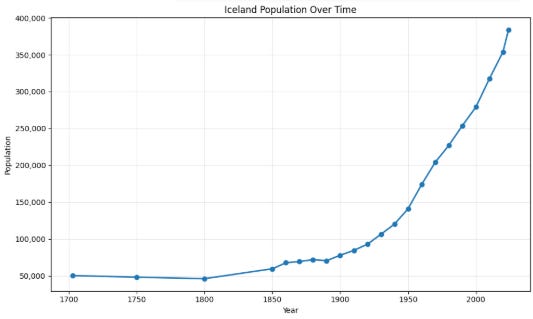
Iceland is following suit in terms of population growth, with the past decade witnessing the steepest increase on record. The conclusion, therefore, is that the EU represents only a small and conspicuous part of the much larger iceberg facing the West.