

The season of Autumn is in full swing. Or is it in Fall? Older English people might remember the time when parts of the UK used to call it Harvest. Onomastics and etymology can be quite fascinating as there is a lot of history to name and word origins.
This article is dedicated to correcting the mispronounced names of some well known figures. To be fair, this issue mostly stems from the use of different orthographies between languages, but there are also some inexplicable corruptions and systemic flaws.
President Xi Jinping is the current political kingpin on the global stage thanks to China’s economic might. I am no fan of his internal policies toward Uyghurs or Christians. It’s actually illegal to hang the Ten Commandments in churches and homes thanks to Xi’s Sinicization efforts. So what might go up instead? The Eleven Commandments of XI? (Not many surnames work as a Roman numerals too)… No, a portrait of the leader suffices.
But how exactly can folks be mispronouncing a name that is only two letters long, you may be asking. The most common ways are “shi,” “zhi” and “ksi.” The ultimate source of the problem is the “X,” because the Chinese learned Latin letters from the Portuguese in Macau. Indeed x = sh in Portuguese orthography. But Chinese pronunciations are often more nuanced than Western ears or orthographies can appreciate. Still, there is a Latin transliteration that could render the name more correctly, the form being Syi. The letter y here is strictly a consonant, as the name is a one-syllable vocalization. The only Westerner I’ve heard pronounce it correctly is Jackson Hinkle, who has been to China a few times and is a communist sympathizer.

Back in the twentieth century, everyone knew how to pronounce the surname of Mikhail Gorbachev. That’s because it was spelled differently: Gorbachov. At some point and for some bizarre reason, the Western transliteration consolidated on Gorbachev. Nowadays Wikipedia is mostly to blame, where a few non-Russian speaking editors must have thought themselves clever when looking at the Russian Cyrillic orthography, which reads “Горбачёв.” But as any true Russophone would know, the letter ё transliterates to yo. Thus, the proper English spelling should be Gorbachyov, with the y being a consonant. Gorbachov is still pretty close though. The weird thing is that the Wikipedia article includes an audio file with the correct pronunciation. Alas, the transliteration error appears too far entrenched and is even in Substack’s spellchecker that is admonishing me as I type this article.
Westerners massacre the name of Genghis Khan much like the warlord used to massacre the poor people of central Asia. Once again, English texts of the past spelled it correctly: Chingis Khan, but for some reason a mistake caught on and became the dominant form Genghis Khan. This is especially annoying since g has its own ambiguity issue of hard and soft forms.
The Kh is also mispronounced, but it’s rather unrealistic to expect English speakers to pronounce the fricative /x/, especially when it is at the start of a word. Scottish people might be able to, since they know how loch should be pronounced. Dutch people too, as they know how to pronounce van Gogh. But given the propensity of English speakers to simplify the kh to a /k/, as in Munich → Myoonik, it would have been better to convert the digraphs kh to just h. This would give us Chingis Han. Closer to the original.
As a side note, the name in question is actually an honorific title meaning universal ruler. His birth name was Temüjin, which sounds a bit like another transcontinental giant: Temu (the Chinese e-commerce platform). Pure coincidence. As for the name Chingis or Cengiz, it remains a popular given name for boys of Turkic or Mongolic ancestry. Rather in poor taste, it must be said.
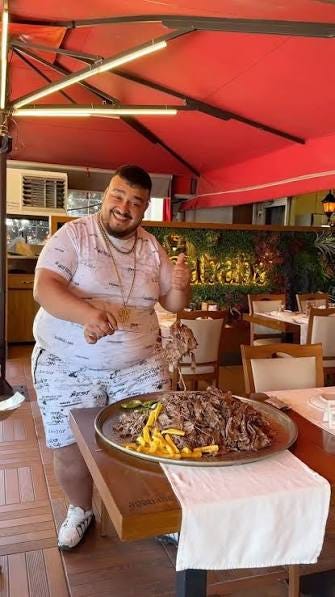
In Turkey, Cengiz can also be a surname, though interestingly the Turkish c is pronounced as a /dʒ/. Could this be the source of the phonetic mutation to English spelling? Arabic might be another source, as it actually lacks the /tʃ/ (ch) sound. As for those who have the surname Cengiz, it would be interesting to conduct DNA testing to see if they have common or similar descent, maybe from the khan himself. Not likely, based on the most well known member of this onomastic tribe, Yasin Cengiz, who only conquers calories as part of his social media grift to promote gluttony.
Finally, some honorable mentions on this list include Albert Camus (pronounced al-BEHR ka-MÜ), Johann Wolfgang von Goethe (pronounced GÖH-tuh) and Leif Erikson (pronounced Leyf not Leaf). Suffice it to say that Western orthographies could do with a reset of some kind, perhaps to a simplified phonetic (fonetik!) standard. Then again, things are becoming so rapidly obsolete it may not even be worth it at all.